Spara
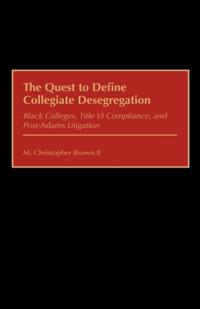
Quest to Define Collegiate Desegregation

Läs i Adobe DRM-kompatibel e-boksläsareDen här e-boken är kopieringsskyddad med Adobe DRM vilket påverkar var du kan läsa den. Läs mer
In 1954, the United States Supreme Court's ruling in Brown v. Board of Education Topeka (347 U.S. 483) overturned the prevailing doctrine of separate but equal introduced by Plessy v. Ferguson (163 U.S. 537) fifty-eight years prior. By the time Brown was decided, many states had created dual collegiate structures of public education, most of which operated exclusively for Caucasians in one system and African Americans in the other.Although Brown focused national attention on desegregation in primary and secondary public education, the issue of disestablishing dual systems of public higher education would come to the forefront two years later in Florida ex rel. Hawkins v. Board of Control (350 U.S. 413 [1956]). However, the pressure to dismantle dual systems of public education was not extended to higher education until the passage of the Civil Rights Act of 1964. Despite Title VI of this Act, which stated that No person in the United States shall, on the ground of race, color, or national origin, be excluded from participation in, or be denied the benefits of, or be subjected to discrimination under any program or activity receiving Federal financial assistance, nineteen states continued to operate dual systems of public higher education. The Quest to Define Collegiate Desegregation explores the evolution of the legal standard for collegiate desegregation after Adams v. Richardson (351 F2d 636 [D.C. Cir. 1972]).
- Undertitel
- Black Colleges, Title VI Compliance, and Post-Adams Litigation
- Författare
- II M. Christopher Brown II
- ISBN
- 9780313005923
- Språk
- Engelska
- Utgivningsdatum
- 1999-05-30
- Tillgängliga elektroniska format
- PDF - Adobe DRM
- Läs e-boken här
- E-boksläsare i mobil/surfplatta
- Läsplatta
- Dator