Spar
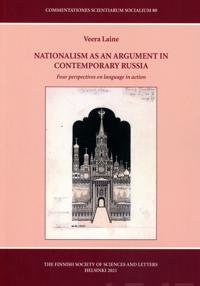
Nationalism as an Argument in Contemporary Russia
This dissertation analyses the uses of the concept of nationalism in Russia from a historical perspective. It is based on four empirical studies examining textual material produced between the years 2000 and 2020. During this time, and after the so-called “conservative turn” in particular, the state leadership in Russia adopted increasingly authoritarian policies vis-à-vis society, and started to portray Russia as being under an external threat. The annexation of Crimea and the onset of the war in Ukraine in 2014 solidified the way in which recent political changes in Russia were characterised as “growing nationalism”.
In this temporal context, the study suggests that nationalist discourses are currently shifting, and traces these shifts in scholarly and everyday language. The negative connotations of nationalism in everyday language affect its scholarly use, which is why the aspects of nationalism as an analytical concept, as well as the complex relationship between the concept and the term itself, are expounded in the study. Following the tradition of critical nationalism studies, the dissertation approaches the ‘nation' as a political claim that results from a constructive process in language. The dissertation draws on the rhetorical tradition of conceptual history in analysing specific concepts, metaphors and narratives within nationalist discourses as a means of framing politics. The way language is used simultaneously defines the boundaries of actual policies. More specifically, the rhetorical choices of politicians map the conditions of belonging to a nation, duly having real implications for people's lives.
In this temporal context, the study suggests that nationalist discourses are currently shifting, and traces these shifts in scholarly and everyday language. The negative connotations of nationalism in everyday language affect its scholarly use, which is why the aspects of nationalism as an analytical concept, as well as the complex relationship between the concept and the term itself, are expounded in the study. Following the tradition of critical nationalism studies, the dissertation approaches the ‘nation' as a political claim that results from a constructive process in language. The dissertation draws on the rhetorical tradition of conceptual history in analysing specific concepts, metaphors and narratives within nationalist discourses as a means of framing politics. The way language is used simultaneously defines the boundaries of actual policies. More specifically, the rhetorical choices of politicians map the conditions of belonging to a nation, duly having real implications for people's lives.
- Undertittel
- Four perspectives on language in action
- Forfatter
- Veera Laine
- ISBN
- 9789516534698
- Språk
- Engelsk
- Vekt
- 500 gram
- Utgivelsesdato
- 1.1.2021
- Forlag
- Suomen Tiedeseura
- Antall sider
- 116