Spar
Role of Aging in Atherosclerosis
Les i Adobe DRM-kompatibelt e-bokleserDenne e-boka er kopibeskyttet med Adobe DRM som påvirker hvor du kan lese den. Les mer
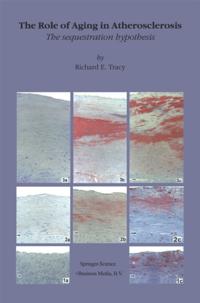
The cover of this book summarizes the central features of the sequestration hypothesis: Commonplace appearances seen in human coronary artery, fat stained in paraffin seetions by a new technique explained in Chapter Eleven, are arranged to suggest pathways of evolution toward atheroma. The hypothesis formulated and defended in the pages ofthis book is this: Fibroplasia progresses upward in column "e;a"e; from "e;la"e; to "e;3a"e; as a characteristic feature of aging. This starts sooner and progresses faster in men than in wornen. Numbers ofSMC's remain essentially constant so that fibroplasia per SMC steadily increases. The rise upward conveys an increasing propensity to sequester atherogenic lipids, causing transition rightward into column "e;b"e;. Sequestered extracellular lipid then attracts fatty streak elements, especially foam cells and lyrnphocytes, to propel the arterial site rightward into column "e;c"e;. Frame "e;lc"e; corresponds to the AHA Lesions Committee classification type IIb, the progression resistant fatty streak arising directly without prior lipid sequestration; this can progress to atheroma, but slowly after much delay, although extreme provocation can accelerate the process. Such progression is rightward toward atherorna with thin cap, not upward toward fibroplastic thickening. Frame "e;2c"e; corresponds to the AHA classification, type Ha, progression prone fatty streaks. These readily evolve into atheroma, again by horizontal progression.
- Undertittel
- The Sequestration Hypothesis
- Forfatter
- R.E. Tracy
- ISBN
- 9789401702638
- Språk
- Engelsk
- Utgivelsesdato
- 9.3.2013
- Forlag
- SPRINGER NETHERLANDS
- Tilgjengelige elektroniske format
- PDF - Adobe DRM
- Les e-boka her
- E-bokleser i mobil/nettbrett
- Lesebrett
- Datamaskin






