Spar
Reuven Ramaty High Energy Solar Spectroscopic Imager (RHESSI) - Mission Description and Early Results
e-bok, 2013
Engelsk
Les i Adobe DRM-kompatibelt e-bokleserDenne e-boka er kopibeskyttet med Adobe DRM som påvirker hvor du kan lese den. Les mer
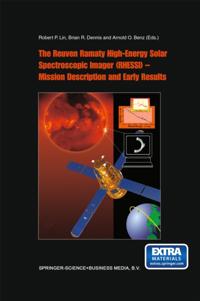
The Reuven Ramaty High Energy Solar Spectroscopic Imager (RHESSI) satellite was launched on 5 February 2002. Its objective is to study the energy release and particle acceleration in solar flares through observations of X-rays and gamma rays. Two novel technologies are combined to obtain both spectra and images over a broad energy range. For the spectroscopy, cooled hyperpure germanium detectors are used to cover the energy range from 3 keV to 17 MeV with unprecedented keV-class resolution. Since focusing optics are not possible for making images with such high energy photons, tungsten and molybdenum absorbing grids are used to modulate the X-rays and gamma-rays coming from the Sun as the spacecraft rotates. This allows the spatial Fourier components of the source to be determined so that images can be made in spectral ranges where astronomical images have never been produced before. These new instrumental techniques require equally innovative software to reconstruct X-ray and gamma-ray spectra and images from the observations. Ample solar activity, abundant observations, and an open data policy have attracted many researchers. Astronomers face in the RHESSI mission an exciting new scientific potential. It has unusually broad possibilities for improving our understanding of the enigmatic solar flare phenomenon that is becoming increasingly important as society depends more and more on space-based technologies. In this volume, the functioning of RHESSI is explained, the data analysis techniques including spectroscopy and image reconstruction are introduced, and the experiences of the first few months of operation are summarized. First scientific results are presented that provide the essential base for more extended studies using RHESSI data and complementary observations by instruments on other spacecraft and at ground-based solar observatories.Scientists and students will find here the latest discoveries in solar flare research, as well as inspiration for future work. The papers will serve as references for the many new discoveries to come from the continuing RHESSI observations.
- Redaktør
- R.P. Lin, Arnold O. Benz, B.R. Dennis
- ISBN
- 9789401734523
- Språk
- Engelsk
- Utgivelsesdato
- 21.12.2013
- Forlag
- SPRINGER NETHERLANDS
- Tilgjengelige elektroniske format
- PDF - Adobe DRM
- Les e-boka her
- E-bokleser i mobil/nettbrett
- Lesebrett
- Datamaskin