Spar
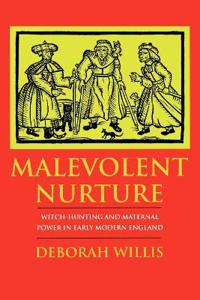
Malevolent Nurture
Why were women far more likely than men to be executed for witchcraft in the early modern period? Questioning approaches that focus narrowly on the male role in witch-hunting in England and Scotland, Deborah Willis examines the fact that women were also frequently the accusers.Willis draws on the strengths of feminist, new historicist, and psychoanalytic criticism and on such primary sources as legal documents, pamphlet literature, religious tracts, and stage plays. Both the witch and her female accuser, Willis concludes, were engaged in a complex, intricate struggle for survival and empowerment in a patriarchal culture, and they stood in uneasy relation to definitions of female identity that rewarded nurturing behavior.Malevolent Nurture disentangles popular images of the witch from those endorsed by male elites. Among villagers, the witch was most typically imagined as a malevolent mother, while elites preferred to view her as a betraying servant of Satan. Analyzing King James VI and I's involvement in the North Berwick witchcraft trials, Willis shows how his elite atittudes were nevertheless influenced by his relationships with his brith mother, Mary Queen of Scots, and another maternal figure, Queen Elizabeth I.Willis also shows that Shakespeare, in Richard III, Macbeth, and Henry VI, and other middle-class playwrights incorporated the beliefs of the ruling class and villagers alike in their representations of witches.
- Undertittel
- Witch-Hunting and Maternal Power in Early Modern England
- Forfatter
- Deborah Willis
- ISBN
- 9780801481949
- Språk
- Engelsk
- Vekt
- 454 gram
- Utgivelsesdato
- 2.11.1995
- Forlag
- Cornell University Press
- Antall sider
- 280