Spar
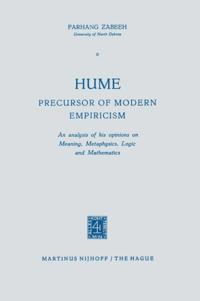
Hume Precursor of Modern Empiricism
Les i Adobe DRM-kompatibelt e-bokleserDenne e-boka er kopibeskyttet med Adobe DRM som påvirker hvor du kan lese den. Les mer
David Hume is the most influential precursor of modern empiri- cism. By modern empiricism, I intend a belief that all cognitive conflicts can be resolved, in principle, by either appeal to matters offact, via scientific procedure, or by appeal to some sets of natural or conventional standards, whether linguistic, mathematical, aes- thetic or political. This belief itself is a consequent of an old appre- hension that all synthetic knowledge is based on experience, and that the rest can be reduced to a set of self-evident truths. In this broad sense, Modern Empiricism encompasses classes, such as Logi- cal Empiricism, Logical Atomism and Philosophical Analysis, and unique individuals such as Russell and Moore. It excludes, thereby, the present day continental philosophies, such as Thomism, Exist- entialism, and Dialectical Materialism. Modern empiricists, to be sure, are influenced by many other phi- losophers. Locke, Berkeley, and Mill, among the classical empiri- cists, and Leibniz and Kant, among the rationalists (the former especially on the logico-mathematical side) in one way or other are responsible for the appearance of empiricism in its new form. But none of them were as influential as Hume. This, by itself is not news. Weinberg, in his well-known book, An Examination of Logical Positivism, observes that: Many, if not all, of the principal doctrines of contemporary positivism derive from Hume.
- Undertittel
- An analysis of his opinions on Meaning, Metaphysics, Logic and Mathematics
- Forfatter
- Farhang Zabeeh
- ISBN
- 9789401191944
- Språk
- Engelsk
- Utgivelsesdato
- 6.12.2012
- Forlag
- SPRINGER NETHERLANDS
- Tilgjengelige elektroniske format
- PDF - Adobe DRM
- Les e-boka her
- E-bokleser i mobil/nettbrett
- Lesebrett
- Datamaskin






