Spar
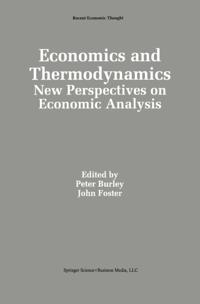
Economics and Thermodynamics
e-bok, 2013
Engelsk
Les i Adobe DRM-kompatibelt e-bokleserDenne e-boka er kopibeskyttet med Adobe DRM som påvirker hvor du kan lese den. Les mer
Over the past two decades we have witnessed something of a revolution in the natural sciences as thermodynamic thinking evolved from an equilibrium, or 'classical', perspective, to a nonequilibrium, or 'self- organisational' one. In this transition, thermodynamics has been applied in new ways and in new fields of inquiry. Chemical and biological (evolutionary) processes have been analysed, increasingly, in non- equilibrium thermodynamical terms. Economics has, since the late 19th century, relied heavily upon metaphors and analogies derived from the natural sciences - mechanical analogies cast in terms of traditional Newtonian physics and expressed in terms of Cartesian logic have been especially popular. Thermodynamics, on the other hand, has been less popular, despite its early application in economics by Stanley Jevons, the father of modern notions of utility maximisation in neoclassical economics, and despite its promotion in economic contexts by Paul Samuelson, the author of the definitive treatise upon which post war neoclassical economic theory was based, namely, his Foundations of Economic Analysis. The general neglect of thermodynamic thinking in economics was brought to our attention by Nicholas Georgescu-Roegen in the late 1960s, by which time economic theory, evidenced in, for example, the Arrow- Debreu general eqUilibrium system, had become so sophisticated that it could not be penetrated by thermodynamical ideas. To Georgescu- Roegen, this presented something of a crisis in economics because neglect of thermodynamics led, in his view, to blindness amongst economists to an economy/environment problem in the global economy.
- Undertittel
- New Perspectives on Economic Analysis
- Redaktør
- Peter Burley, John Foster
- ISBN
- 9789401582698
- Språk
- Engelsk
- Utgivelsesdato
- 9.3.2013
- Forlag
- SPRINGER NETHERLANDS
- Tilgjengelige elektroniske format
- PDF - Adobe DRM
- Les e-boka her
- E-bokleser i mobil/nettbrett
- Lesebrett
- Datamaskin






