Spar
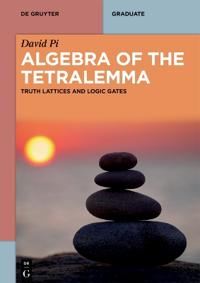
Algebra of the Tetralemma
The key Buddhist concept of non-duality is emptiness, i.e. that which is neither existence nor non-existence. The first step in formalizing Buddhist logic is to recognize that a non-duality corresponds to a contradiction in conventional logic. Although there are several well-developed logical systems available that allow contradictions and violations of the law of excluded middle, we have elected to work within the framework of the de Morgan algebra. This system is relatively simple and sufficiently flexible to allow mystical interpretation.
The tetralemma is the most important instrument of Buddhist logic. It is marked by four premises: existence; non-existence; both; and neither. In this context, “neither” corresponds to emptiness and “both” corresponds to non-emptiness. This is a radical departure from conventional logic, because we are examining the emptiness or non-emptiness of propositions rather than sets. We proceed by identifying the four premises as four logic gates instead of four truth-values. Consequently, the four premises acquire a transcendental meaning: emptiness; non-emptiness; both; neither. In this form, “neither” corresponds to the emptiness of emptiness and “both” corresponds to the non-emptiness of emptiness.
- Undertittel
- Truth Lattices and Logic Gates
- Forfatter
- Stephen A. Clark
- ISBN
- 9783112235805
- Språk
- Engelsk
- Vekt
- 500 gram
- Serie
- De Gruyter Textbook
- Utgivelsesdato
- 1.6.2026
- Forlag
- De Gruyter
- Antall sider
- 148






