Spar
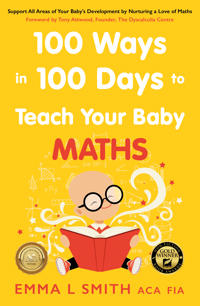
100 Ways in 100 Days to Teach Your Baby Maths
Maths ability on entry to school is the strongest predictor of later academic achievement, double that of literacy skills, and simply saying more number words to babies increases their maths ability. What else have scientists, psychologists and professors learned about maths for babies?
- Babies seem to be born with an amazing number sense: understanding shapes in the womb, being aware of quantities at seven hours old, calculating probability at six months old, and doing addition and subtraction at nine months old.
- The best time to introduce maths is infancy. By the time children enter school there is already a significant gap in maths skills, this gap increases over time.
- A parent’s attitude shapes a child’s attitude. Parents have the power to teach their babies that learning maths can be either something to feel anxious about or something to enjoy.
- Babies can learn maths while boosting all other areas of development. For example, movement is boosted while teaching geometry positional language, literacy is boosted while reading a “number” book, and bonding is boosted by giving a baby undivided attention while teaching maths to him or her.
- Maths is important. Babies will use maths every day for the rest of their lives.
What about the impact of gender, culture, videos, sleep, diet—even the type of pushchair you buy? 100 Ways in 100 Days to Teach Your Baby Maths holds the answers.
- Undertittel
- Support All Areas of Your Baby’s Development by Nurturing a Love of Maths
- Forfatter
- Emma Smith
- Alder
- 3-6 år
- ISBN
- 9781800464490
- Språk
- Engelsk
- Vekt
- 310 gram
- Utgivelsesdato
- 28.9.2021
- Forlag
- TROUBADOR PUBLISHING
- Antall sider
- 240






