Tallenna
Time as Emergent from Dependency
Lue Adobe DRM-yhteensopivassa e-kirjojen lukuohjelmassaTämä e-kirja on kopiosuojattu Adobe DRM:llä, mikä vaikuttaa siihen, millä alustalla voit lukea kirjaa. Lue lisää
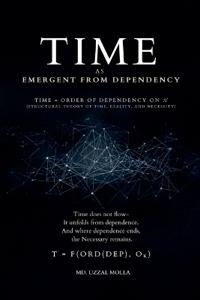
Time as Emergent from Dependency presents a bold rethinking of one of the most fundamental assumptions in science and philosophy: the nature of time. Instead of treating time as a primary dimension in which reality unfolds, this work argues that time is not fundamental-it is emergent.The central thesis is simple:Time does not carry existence.Time emerges from it.At the foundation of this framework lies dependency (Dep)-a structural relation in which one element exists only if another is ontologically prior. From this principle, reality is reconstructed not as a temporal sequence, but as a relational structure.To formalize this, the book introduces a unified system:𝓤 = {Li, Ej, Ok, Ml}Where laws, events, observers, and moral constraints form a complete structural field. Within this system, time arises as an ordering of dependency:T = Ord(Dep)T = f(Dep, Ok)Thus, time is not an independent entity but an interpreted ordering of relations, completed through observation.This leads to several key conclusions:Time does not flowTime is not a dimensionTime does not cause changeTime is observer-dependentInstead, what we experience as time is the interpretation of structural change:Memory = resolved dependencyFuture = unresolved dependencyBecoming = reconfiguration of relationsA central philosophical result is the rejection of infinite regress in dependency chains. This leads to the necessity of a non-dependent ground:∃𝓝 such that Dep(𝓝) = ∅This ground (𝓝) is not within reality but the condition of its possibility-beyond time, change, and dependency.The full structure can be expressed as:𝓝 → 𝓤 → Dep → Ord(Dep) → TThis is not a temporal sequence, but a hierarchy of emergence.Ultimately, the book proposes a shift from temporal ontology to structural ontology. Reality is not something that unfolds in time; rather, time is the final interpretive layer of a deeper relational structure.Reality is not in time.Time is in reality.This work offers a unified framework connecting physics, philosophy, and metaphysics—challenging deeply held assumptions and presenting a coherent alternative grounded in dependency, structure, and necessity.
- Kirjailija
- Md. Uzzal Molla
- ISBN
- 9798235625747
- Kieli
- englanti
- Julkaisupäivä
- 18.5.2026
- Kustantaja
- Distributed via Draft2Digital
- Formaatti
- Epub - Adobe DRM
- Lue e-kirjoja täällä
- Lue e-kirja mobiililaitteella/tabletilla
- Lukulaite
- Tietokone