Siirry suoraan sisältöön
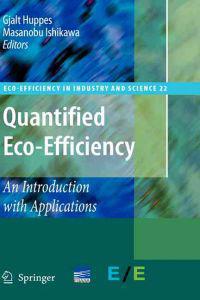
Quantified Eco-Efficiency
Tallenna

Quantified Eco-Efficiency

A central asset of eco-efficiency analysis is that it does not depend on a specific evaluation of environmental impacts against economic effects, avoiding the often disputed results of neo-classical evaluation methods. For integrating the different environmental scores several evaluation methods may be used including those based on willingness-to-pay, panel procedures, and public statements on policy goals.

A substantial Japanese paper on Maximum Abatement Cost method and a paper on revealed public preferences in The Netherlands comprise the first section on methods. Next, there are four sections on domains of application of eco-efficiency analysis. In the Agriculture section, a case on conservation agriculture in China is worked out, using input-output analysis. In the Industry section, cases range from supply chain management to waste water management and methods to speed up innovation. In the Products & Consumption section, cases refer to overall household performance, specific energy products and methods for upgradeable product design. Finally, in the Recycling section, cases relate to increasing the supply of secondary materials and to increasing secondary materials use.

Alaotsikko
An Introduction with Applications
Painos
Softcover reprint of hardcover 1st ed. 2007
ISBN
9789048173600
Kieli
englanti
Paino
310 grammaa
Julkaisupäivä
20.11.2010
Kustantaja
Springer
Sivumäärä
332