Tallenna
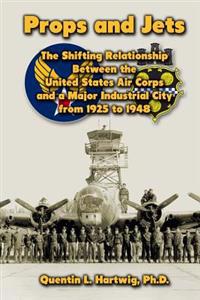
Props and Jets: The Shifting Relationship Between the United States Air Corps and a Major Industrial City from 1925 to 1948
Merriam Press Aviation History Series
June 25, 1925, inauguration of Rodgers Field marked the beginning of Allegheny County Commissioners' investment into commercial aviation. A modest acquisition of 40 acres that has with time evolved to the presence of the 1500 acre Pittsburgh International Airport across town. This book chronicles the dreams, successes, failures, promises, and fatalities in the intervening events from 1923 to the opening of the commercial terminal at the Greater Pittsburgh Airport (GRP) in 1952. Over time, Rodgers Field, the first field, could not be enlarged, expansion of Allegheny County Airport, the second field, proved too expensive, with GRP, the third field, finally large enough to fill the needs of the commercial and military needs.In the 1920s and 1930s the political leadership of Allegheny County struggled to craft the best aviation facility to attract military and commercial interests. Experience with the shortcomings of Rodgers Field provided guidance in the design of the Allegheny County Airport.
During World War II, Pittsburgh lay in the flight path of immense numbers of thirsty military aircraft being flown from one area of the United States to another. The breadth of the Greater Pittsburgh Airport provided the necessary space for runways and parking areas to accommodate the impressive traffic landing for refueling, maintenance and repair. In that time period, the media devoted most of their attention to the battle arenas, in foreign lands and on distant oceans.
Conflicts won meant yet another step to victory when the United States service men and women could return home. But the success 'over there' was totally dependent upon the war production system 'over here.' In addition to the military history of Rodgers Field, this work details the worthy participation 'over here' of the two Allegheny County airfields.
Contents
Rodgers Field: Pittsburgh's First Municipal/Military Airport (Doomed From The Start)
One Of The Best
Only A Presidential Intervention Could Save This Local Airman
ACA: A Push For Prominence In The Air
The 575th Of The Air Transport Command Begins At ACA
An Approaching Storm
Tora Tora
Conversion Of The Bell Farm Into A CAA National Defense Airport
Further Sources Of Delays In Construction Of The Moon Township Defense Air Field During 1943-1944
The 575th Begin Operations At The Greater Pittsburgh Airport
Luftwaffe Sorties Over Pittsburgh
Personal Recollections About The Army Air Base: Greater Pittsburgh Airport
Donuts
Heroes Past Always Present
Looking Back: It Never Happened
A New Mission In Response To An Iron Curtain: Soviet Threat Always a Dubious Ally
Auxiliary Reserve Training Sites
Appendices
Commanders of the 575th Base Unit, 6th Ferrying Station (ACA) and the 444th Base Unit, Reserve Training, Air Defense Command, Grp
Major and Minor Military Aircraft Accidents at Rodgers Field, ACA, GRP, or Nearby
Military Personnel Stationed at ACA and/or GRP at Some Time During the Time Span 1942-1950
Air Traffic Controllers at ACA During World War II
Members of the 324th Observation Squadron, 99th Division, US Army 3rd Air Corps, Rodgers Field, Aspinwall, Pa, and Allegheny County Airport
Aviation Mechanics at Rodgers Field in 1928
Abbreviations
Index
162 photos, illustrations, drawings, documents
- Kirjailija
- Quentin L. Hartwig
- ISBN
- 9781484995228
- Kieli
- englanti
- Paino
- 531 grammaa
- Julkaisupäivä
- 1.5.2013
- Sivumäärä
- 364






