Tallenna
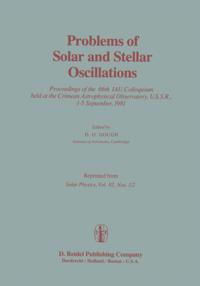
Problems of Solar and Stellar Oscillations
e-kirja, 2012
englanti
Lue Adobe DRM-yhteensopivassa e-kirjojen lukuohjelmassaTämä e-kirja on kopiosuojattu Adobe DRM:llä, mikä vaikuttaa siihen, millä alustalla voit lukea kirjaa. Lue lisää
D. O. GOUGH Institute of Astronomy. Madingley Road. Cambridge. U. K. IAU Colloquium 66 on 'Problems of Solar and Stellar Oscillations' was held at the Crimean Astrophysical Observatory, U. S. S. R. , on 1-5 September, 1981. The principal purpose of the colloquium was to study the low-amplitude oscillations of the Sun and, to a lesser extent, to consider similar oscillations of other stars. Much of the emphasis of the discussions was on the diagnostic value of the oscilla- tions. In the last few years we have become aware that the frequencies of the five-minute modes of high degree, which constitute the major component of the oscillations discovered twenty years ago by Evans and Michaud, can be used to put quite tight bounds on the stratification of the solar convection zone. These permit a calibration of solar models computed from so-called standard evolution theory. Modes of low degree penetrate beneath the convection zone to the core of the Sun, and can in principle test the evolution theory. Therefore there was considerable interest in the reports of the latest observations of such modes. Broadly speaking, those observations confirm the cali- bration by the high-degree modes, but there remain some systematic discrepancies that demand some revision of the theory. Besides the gross aspects of evolution theory, there are also more intricate details to be understood.
- Alaotsikko
- Proceedings of the 66th IAU Colloquium held at the Crimean Astrophysical Observatory, U.S.S.R., 1-5 September, 1981
- Toimittaja
- D.O. Gough
- ISBN
- 9789400970885
- Kieli
- englanti
- Julkaisupäivä
- 6.12.2012
- Kustantaja
- SPRINGER NETHERLANDS
- Formaatti
- PDF - Adobe DRM
- Lue e-kirjoja täällä
- Lue e-kirja mobiililaitteella/tabletilla
- Lukulaite
- Tietokone







