Tallenna
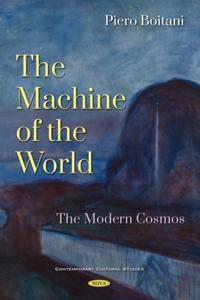
Machine of the World: The Modern Cosmos
Lue Adobe DRM-yhteensopivassa e-kirjojen lukuohjelmassaTämä e-kirja on kopiosuojattu Adobe DRM:llä, mikä vaikuttaa siihen, millä alustalla voit lukea kirjaa. Lue lisää
The World Machine is the second volume Piero Boitani devotes to the way in which the sciences and the arts interact when it comes to modern consideration of the stars and the cosmos (the first, also published in English by Nova Science Publishers, is entitled Looking Upwards: Stars in Ancient and Medieval Cultures). This is not a history of astronomy or astrophysics, but the story - arranged in chronological order - of how humans have reacted to fundamental changes in astronomy by means of poetry, narrative, painting, architecture, and music over the last five hundred years. This time, the story is basically European (and American), as all the relevant scientific discoveries were made in Europe, and it is the European imaginaire that dominates world culture (non-European images of the universe are dealt with in Looking Upwards). The historical development of this image and of the ideas that contribute to its formation is rather complex and diversified, but two major turning points are clearly identifiable - one lies between the sixteenth and seventeenth century, and one at the very beginning of the twentieth century. Concerning the former, the observation of the sky was revolutionized by the telescope. Galileo, Kepler and Newton could thus base their new models of the universe on much more precise experiences, and mathematics became the new language of astronomy. The cosmos increasingly tended to be viewed as a "e;machine,"e; a mechanism like a clock (hence the book's title). Between the end of the nineteenth and the beginning of the twentieth century the second scientific revolution took place. The instruments became so refined that they began to detect increasingly remote objects, and the phenomena found in the sky, as well as their behavior, no longer fully responded to Newtonian laws. New theories - relativity and quantum mechanics - were elaborated, the mathematics needed for them becoming much more difficult for the layman, and the whole structure of matter, with the discovery of the atom, its constituent parts, and its particles was gradually uncovered. Things reached a critical moment with Heisenberg's and Hubble's formulation of, respectively, the "e;uncertainty principle"e; and of the increasing speed at which galaxies recede from us the further they are - and finally with the conflict between relativity and quantum theories. Some recent poets (notably in South America) and many painters and musicians in Europe and North America have tried to describe this new cosmos, but the same happened after the first scientific revolution. In short, The Machine of the World recounts an exciting adventure whose protagonists are the likes of Tasso and Milton, Goethe and Wallace Stevens, Canaletto and Friedrich, Verdi and Puccini, Van Gogh and Schoenberg, Joyce and Thomas Mann.
- Kirjailija
- Piero Boitani
- ISBN
- 9781536144963
- Kieli
- englanti
- Julkaisupäivä
- 27.12.2018
- Kustantaja
- Nova Science Publishers, Inc.
- Formaatti
- PDF - Adobe DRM
- Lue e-kirjoja täällä
- Lue e-kirja mobiililaitteella/tabletilla
- Lukulaite
- Tietokone