Tallenna
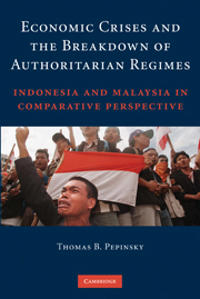
Economic Crises and the Breakdown of Authoritarian Regimes
Why do some authoritarian regimes topple during financial crises, while others steer through financial crises relatively unscathed? In this book, Thomas B. Pepinsky uses the experiences of Indonesia and Malaysia and the analytical tools of open economy macroeconomics to answer this question. Focusing on the economic interests of authoritarian regimes' supporters, Pepinsky shows that differences in cross-border asset specificity produce dramatically different outcomes in regimes facing financial crises. When asset specificity divides supporters, as in Indonesia, they desire mutually incompatible adjustment policies, yielding incoherent adjustment policy followed by regime collapse. When coalitions are not divided by asset specificity, as in Malaysia, regimes adopt radical adjustment measures that enable them to survive financial crises. Combining rich qualitative evidence from Southeast Asia with cross-national time-series data and comparative case studies of Latin American autocracies, Pepinsky reveals the power of coalitions and capital mobility to explain how financial crises produce regime change.
- Alaotsikko
- Indonesia and Malaysia in Comparative Perspective
- Kirjailija
- Thomas B. Pepinsky
- ISBN
- 9780521767934
- Kieli
- englanti
- Paino
- 600 grammaa
- Julkaisupäivä
- 17.8.2009
- Kustantaja
- Cambridge University Press
- Sivumäärä
- 344