Tallenna
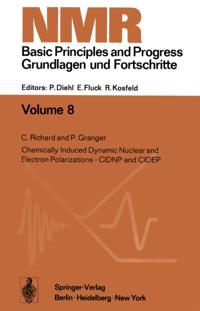
Chemically Induced Dynamic Nuclear and Electron Polarizations-CIDNP and CIDEP
Lue Adobe DRM-yhteensopivassa e-kirjojen lukuohjelmassaTämä e-kirja on kopiosuojattu Adobe DRM:llä, mikä vaikuttaa siihen, millä alustalla voit lukea kirjaa. Lue lisää
Anomalous electron-spin state populations in the Electron Paramagnetic Re- sonance (EPR) spectra of radicals formed during radio lysis experiments were observed in 1963 by FESSENDEN and SCHULER [170a]. This phenomenon did not receive much attention at the time. In 1967, BARGON, FISCHER, and JOHNSEN [5] and independently WARD and LAWLER [7,8] reported a similar phenomenon for Nuclear Magnetic Resonance (NMR) spectra taken during radical reactions: emission or enhanced absorption, or both. The earliest attempts to explain this new NMR phenomenon treated these effects in a way similar to that of Dynamic Nuclear Polarization (DNP) or the Overhauser effect. Although the polarization has a completely different origin, DNP gave its name to this effect: Chemically Induced Dynamic Nuclear Polariza- tion (CIDNP). [The name Chemically Induced Dynamic Electron Polarization (CIDEP) was introduced later by analogy with CIDNP]. After the initial publica- tions, all the new data demonstrated that the first theory could not be correct. In 1969, a new theory was proposed by CLOSS [18] and independently by KAPTEIN and OOSTERHOFF [23] and called the radical-pair theory. This mechanism was proposed to account for the observations of polarization in both NMR and EPR. The radical-pair theory is based on weak interactions in a pair of radicals: the strength of interaction between the electronic states of the radicals depends in particular on the nuclear-spin states.
- Kirjailija
- C. Richard, P. Granger
- ISBN
- 9783642657931
- Kieli
- englanti
- Julkaisupäivä
- 6.12.2012
- Kustantaja
- Springer Berlin Heidelberg
- Formaatti
- PDF - Adobe DRM
- Lue e-kirjoja täällä
- Lue e-kirja mobiililaitteella/tabletilla
- Lukulaite
- Tietokone







