Tallenna
Models of Neural Networks
e-kirja, 2013
englanti
Lue Adobe DRM-yhteensopivassa e-kirjojen lukuohjelmassaTämä e-kirja on kopiosuojattu Adobe DRM:llä, mikä vaikuttaa siihen, millä alustalla voit lukea kirjaa. Lue lisää
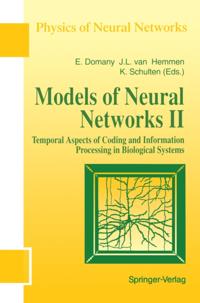
Since the appearance of Vol. 1 of Models of Neural Networks in 1991, the theory of neural nets has focused on two paradigms: information coding through coherent firing of the neurons and functional feedback. Information coding through coherent neuronal firing exploits time as a cardinal degree of freedom. This capacity of a neural network rests on the fact that the neuronal action potential is a short, say 1 ms, spike, localized in space and time. Spatial as well as temporal correlations of activity may represent different states of a network. In particular, temporal correlations of activity may express that neurons process the same "e;object"e; of, for example, a visual scene by spiking at the very same time. The traditional description of a neural network through a firing rate, the famous S-shaped curve, presupposes a wide time window of, say, at least 100 ms. It thus fails to exploit the capacity to "e;bind"e; sets of coherently firing neurons for the purpose of both scene segmentation and figure-ground segregation. Feedback is a dominant feature of the structural organization of the brain. Recurrent neural networks have been studied extensively in the physical literature, starting with the ground breaking work of John Hop- field (1982).
- Alaotsikko
- Temporal Aspects of Coding and Information Processing in Biological Systems
- Toimittaja
- Klaus Schulten, J. Leo van Hemmen, Eytan Domany
- ISBN
- 9781461243205
- Kieli
- englanti
- Julkaisupäivä
- 11.11.2013
- Kustantaja
- SPRINGER NEW YORK
- Formaatti
- PDF - Adobe DRM
- Lue e-kirjoja täällä
- Lue e-kirja mobiililaitteella/tabletilla
- Lukulaite
- Tietokone