Spara
Roman Gold from Tresminas (Portugal)

Reconstruction at Tresminas in Portugal of Roman mining activities in a primary deposit during the 1st and 2nd centuries AD has been made possible thanks to the excellent preservation of ancient. This book is an important contribution to the economic history of ancient Greece and Rome, the archaeology of mining and the history of technology. Decades of on-site research and careful documentation of the monuments have faciliated the understanding of the work processes presented in this volume: prospection, excavation and processing.
Within this framework, prospecting not only served the discovery of deposits as reported by ancient sources, but it accompanied the miners' daily work and was an essential element of the mining process. A special insight into the conditions in an ancient mine is given by the evidence of a catastrophe underground with a subsequent rescue operation.
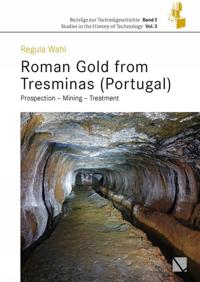
The mining itself has left traces that enable us to both follow and understand the progress of mining over time. The planning and execution that become visible as a result of this allow us to infer a central organisation. The fantastic extensive high galleries of Tresminas, whose dimensions and state of preservation still impress visitors and researchers today are a further example of this. Finds that were abandoned, never completed or destroyed in ancient times are particularly helpful in understanding the mining process.
The complex processing of the gold-bearing ores has left behind in Tresminas around 1 000 stamp mills, countless rock-grinding mills and enormous ore washing structures.
In addition, the water management system associated with mining and settlement is discussed. An important part of the industrial complex was also the local stone quarrying for the production of stamp mills, rock-grinding and grain mills.
A summary of the historical context of the territorium metallorum Tresminas / Jales is presented in the introduction.
An important contribution to further research into the ancient Greek and Roman economic history, Archaeology of mining and history of technology.
Within this framework, prospecting not only served the discovery of deposits as reported by ancient sources, but it accompanied the miners' daily work and was an essential element of the mining process. A special insight into the conditions in an ancient mine is given by the evidence of a catastrophe underground with a subsequent rescue operation.
The mining itself has left traces that enable us to both follow and understand the progress of mining over time. The planning and execution that become visible as a result of this allow us to infer a central organisation. The fantastic extensive high galleries of Tresminas, whose dimensions and state of preservation still impress visitors and researchers today are a further example of this. Finds that were abandoned, never completed or destroyed in ancient times are particularly helpful in understanding the mining process.
The complex processing of the gold-bearing ores has left behind in Tresminas around 1 000 stamp mills, countless rock-grinding mills and enormous ore washing structures.
In addition, the water management system associated with mining and settlement is discussed. An important part of the industrial complex was also the local stone quarrying for the production of stamp mills, rock-grinding and grain mills.
A summary of the historical context of the territorium metallorum Tresminas / Jales is presented in the introduction.
An important contribution to further research into the ancient Greek and Roman economic history, Archaeology of mining and history of technology.
- Undertitel
- Prospec-tion - Mining - Treatment
- Författare
- Regula Wahl-Clerici
- ISBN
- 9783906897431
- Språk
- Engelska
- Vikt
- 446 gram
- Utgivningsdatum
- 2020-11-27
- Sidor
- 280







