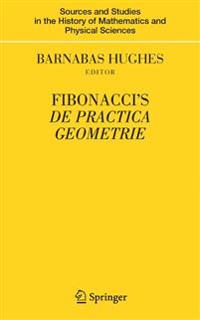
Fibonacci's De Practica Geometrie
Författare:
Häftad, 2010
engelska
1 725 kr

Spara till önskelista
Leonardo da Pisa, perhaps better known as Fibonacci (ca. 1170 – ca. 1240), selected the most useful parts of Greco-Arabic geometry for the book known as De practica geometrie. Beginning with the definitions and constructions found early on in Euclid’s Elements, Fibonacci instructed his reader how to compute with Pisan units of measure, find square and cube roots, determine dimensions of both rectilinear and curved surfaces and solids, work with tables for indirect measurement, and perhaps finally fire the imagination of builders with analyses of pentagons and decagons. His work exceeded what readers would expect for the topic. Practical Geometry is the name of the craft for medieval landmeasurers, otherwise known as surveyors in modern times. Fibonacci wrote De practica geometrie for these artisans, a fitting complement to Liber abbaci. He had been at work on the geometry project for some time when a friend encouraged him to complete the task, which he did, going beyond the merely practical, as he remarked, “Some parts are presented according to geometric demonstrations, other parts in dimensions after a lay fashion, with which they wish to engage according to the more common practice.”
This translation offers a reconstruction of De practica geometrie as the author judges Fibonacci wrote it. In order to appreciate what Fibonacci created, the author considers his command of Arabic, his schooling, and the resources available to him. To these are added the authors own views on translation and remarks about prior Italian translations. A bibliography of primary and secondary resources follows the translation, completed by an index of names and special words.
- Författare
- Hughes Barnabas
- ISBN
- 9781441925015
- Språk
- engelska
- Vikt
- 281 gram
- Utgivningsdatum
- 2010-11-29
- Sidor
- 412