Composite Materials
2 762 kr

Spara till önskelista
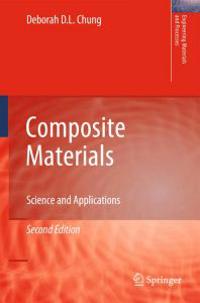
The ?eld of composite materials has progressed greatly over the last few decades, as shown by the widespread use of ?brous composite - terials for airframes, sporting goods and other lightweight structures. Enabling this technological progress is scienti?c understanding of the design and mechanics of composite materials that involve continuous ?bers as the reinforcement. Current challenges in the ?eld of composite materials are associated with the extension of the ?eld of composite materials from structural composites to functional and multifunctional composites, the dev- opment of composite materials for electrical, thermal and other fu- tional applications that are relevant to current technological needs, and the improvement of composite materials through processing. Ex- ples of functions are joining (e. g. , brazing), repair, sensing, actuation, deicing (as needed for aircraft and bridges), energy conversion (as needed to generate clean energy), electrochemical electrodes, el- trical connection, thermal contact improvement and heat dissipation (i. e. , cooling, as needed for microelectronics and aircraft).
Processing includes the use of additives (which may be introduced as liquids or solids), the combined use of ?llers (including discontinuous ones) at the micrometer and nanometer scales, the formation of hybrids (such as organic-inorganic hybrids), the modi?cation of the interfaces in a composite, and control over the microstructure. In other words, the development of composite materials for current technological needs must be application driven and process oriented. This is in contrast to the conventional composites engineering approach, which focuses on mechanics and purely structural applications.
- Undertitel
- Science and Applications
- Författare
- Chung Deborah D. L.
- Upplaga
- 2
- ISBN
- 9781447125471
- Språk
- engelska
- Vikt
- 281 gram
- Utgivningsdatum
- 2012-05-04
- Förlag
- Springer London
- Sidor
- 371