Spara
CMOS Self-Powered Front-End Architecture for Subcutaneous Event-Detector Devices

Läs i Adobe DRM-kompatibel e-boksläsareDen här e-boken är kopieringsskyddad med Adobe DRM vilket påverkar var du kan läsa den. Läs mer
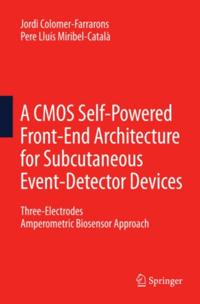
A CMOS Self-Powered Front-End Architecture for Subcutaneous Event-Detector Devices presents the conception and prototype realization of a Self-Powered architecture for subcutaneous detector devices. The architecture is designed to work as a true/false (event detector) or threshold level alarm of some substances, ions, etc... that are detected through a three-electrodes amperometric BioSensor approach. The device is envisaged as a Low-Power subcutaneous implantable application powered by an inductive link, one emitter antenna at the external side of the skin and the receiver antenna under the skin. The sensor is controlled with a Potentiostat circuit and then, a post-processing unit detects the desired levels and activates the transmission via a backscattering method by the inductive link. All the instrumentation, except the power module, is implemented in the so called BioChip. Following the idea of the powering link to harvest energy of the magnetic induced link at the implanted device, a Multi-Harvesting Power Chip (MHPC) has been also designed.
- Undertitel
- Three-Electrodes Amperometric Biosensor Approach
- Författare
- Pere MIRIBEL, Jordi Colomer-Farrarons
- ISBN
- 9789400706866
- Språk
- Engelska
- Utgivningsdatum
- 2011-02-17
- Förlag
- SPRINGER NETHERLANDS
- Tillgängliga elektroniska format
- PDF - Adobe DRM
- Läs e-boken här
- E-boksläsare i mobil/surfplatta
- Läsplatta
- Dator







