Spara
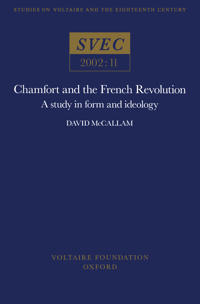
Chamfort and the French Revolution

Sébastien-Roch Nicolas Chamfort remains one of the most enigmatic ‘prompters’ of the French Revolution. This study analyses his rhetorical and political programmes in tandem to reveal how Chamfort’s discourse and politics inform and elucidate one another in both pre-revolutionary and revolutionary periods. It considers his key political texts – his ‘Discours à l’Académie française’, Des académies, the Tableaux historiques de la Révolution française and his posthumous Maximes et pensées, caractères et anecdotes – and exposes how, in each instance, Chamfort’s conception of politics hinges on the adoption and subversion of prescribed discursive forms (reception speech, historical tableau, maxim).
In the ‘Discours’ and Des académies, Chamfort opposes the implicit discursive norm of le bon usage sanctioned by the Académie française, because it represses free expression and at the same time constitutes the Académie itself into an oppressive corporation imbued with neo-feudal values. Chamfort’s subsequent interpretations of revolutionary events in his Tableaux historiques, while making explicit this same radical libertarianism, frame some reservations about the insurgent peuple as a political force. In the end, many of the tensions troubling Chamfort’s politics are resolved by his posthumous Maximes et pensées, whose prevailing principle of honnêteté gives them a rhetorical and political independence from both the ancien régime, centred on notions of honneur, and the revolutionary Republic, founded on a principle of vertu.
Previous studies have tended either to interpret Chamfort’s works from their historical or biographical context, or – by considering exclusively the Maximes et pensées – to subordinate them to an established literary tradition. This innovative reading posits Chamfort’s texts as an exemplary meeting-place of literary practice and political praxis at the time of the Revolution, shedding new light on both the function of literary forms in Chamfort’s politics and the role of Chamfort the writer, as an ideological subject caught up in revolutionary events.
In the ‘Discours’ and Des académies, Chamfort opposes the implicit discursive norm of le bon usage sanctioned by the Académie française, because it represses free expression and at the same time constitutes the Académie itself into an oppressive corporation imbued with neo-feudal values. Chamfort’s subsequent interpretations of revolutionary events in his Tableaux historiques, while making explicit this same radical libertarianism, frame some reservations about the insurgent peuple as a political force. In the end, many of the tensions troubling Chamfort’s politics are resolved by his posthumous Maximes et pensées, whose prevailing principle of honnêteté gives them a rhetorical and political independence from both the ancien régime, centred on notions of honneur, and the revolutionary Republic, founded on a principle of vertu.
Previous studies have tended either to interpret Chamfort’s works from their historical or biographical context, or – by considering exclusively the Maximes et pensées – to subordinate them to an established literary tradition. This innovative reading posits Chamfort’s texts as an exemplary meeting-place of literary practice and political praxis at the time of the Revolution, shedding new light on both the function of literary forms in Chamfort’s politics and the role of Chamfort the writer, as an ideological subject caught up in revolutionary events.
- Undertitel
- A Study in Form and Ideology
- Författare
- David McCallam
- ISBN
- 9780729408011
- Språk
- Franska
- Vikt
- 280 gram
- Utgivningsdatum
- 2002-11-01
- Förlag
- Voltaire Foundation
- Sidor
- 199