Spara
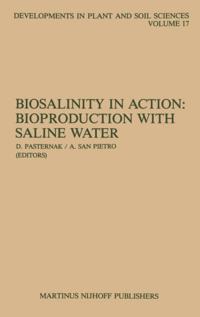
Biosalinity in Action: Bioproduction with Saline Water
e-bok, 2012
Engelska

Läs i Adobe DRM-kompatibel e-boksläsareDen här e-boken är kopieringsskyddad med Adobe DRM vilket påverkar var du kan läsa den. Läs mer
Historically, scientists and laymen have regarded salinity as a hazar- dous, detrimental phenomenon. This negative view was a principal reason for the lack of agricultural development of most arid and semi- arid zones of the world where the major sources of water for biological production are saline. The late Hugo Boyko was probably the first scientist in recent times to challenge this commonly held, pessimistic view of salinity. His research in Israel indicated that many plants can be irrigated with saline water, even at seawater strength, if they are in sandy soil - a technique that could open much barren land to agriculture. This new, even radical, approach to salinity was clearly enunciated in the book he edited and most appropriately entitled 'Salinity and Aridity: New Approaches to Old Problems' (1966). A decade later, three members of the United States National Science Foundation (NSF), Lewis Mayfield, James Aller and Oskar Zaborsky, formulated the 'Biosaline Concept'; namely, that poor soils, high solar insolation and saline water, which prevail in arid lands, should be viewed as useful resources rather than as disadvantages, and that these resources can be used for non-traditional production of food, fuels and chemicals. The First International Workshop on Biosaline Research was con- vened at Kiawah Island, South Carolina, in 1977 by A. San Pietro.
- Redaktör
- Anthony San Pietro, D. Pasternak
- ISBN
- 9789400951112
- Språk
- Engelska
- Utgivningsdatum
- 2012-12-06
- Förlag
- SPRINGER NETHERLANDS
- Tillgängliga elektroniska format
- PDF - Adobe DRM
- Läs e-boken här
- E-boksläsare i mobil/surfplatta
- Läsplatta
- Dator







