Spara
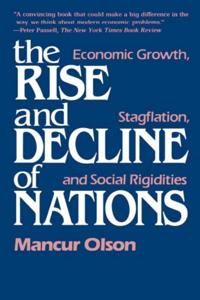
Rise and Decline of Nations

Läs i Adobe DRM-kompatibel e-boksläsareDen här e-boken är kopieringsskyddad med Adobe DRM vilket påverkar var du kan läsa den. Läs mer
The years since World War II have seen rapid shifts in the relative positions of different countries and regions. Leading political economist Mancur Olson offers a new and compelling theory to explain these shifts in fortune and then tests his theory against evidence from many periods of history and many parts of the world."e;[T]his elegant, readable book. . . sets out to explain why economies succumb to the 'British disease,' the kind of stagnation and demoralization that is now sweeping Europe and North America. . . . A convincing book that could make a big difference in the way we think about modern economic problems."e;-Peter Passell, The New York Times Book Review"e;Schumpeter and Keynes would have hailed the insights Olson gives into the sicknesses of the modern mixed economy."e;-Paul A. Samuelson, Massachusetts Institute of Technology"e;One of the really important books in social science of the past half-century."e;-Scott Gordon, The Canadian Journal of Economics"e;The thesis of this brilliant book is that the longer a society enjoys political stability, the more likely it is to develop powerful special-interest lobbies that in turn make it less efficient economically."e;-Charles Peters, The Washington Monthly"e;Remarkable. The fundamental ideas are simple, yet they provide insight into a wide array of social and historical issues. . . . The Rise and Decline of Nations promises to be a subject of productive interdisciplinary argument for years to come."e;-Robert O. Keohane, Journal of Economic Literature"e;I urgently recommend it to all economists and to a great many non-economists."e;-Gordon Tullock, Public Choice"e;Olson's theory is illuminating and there is no doubt that The Rise and Decline of Nations will exert much influence on ideas and politics for many decades to come."e;-Pierre Lemieux, ReasonCo-winner of the 1983 American Political Science Association's Gladys M. Kammerer Award for the best book on U.S. national policy
- Undertitel
- Economic Growth, Stagflation, and Social Rigidities
- Författare
- Olson Mancur Olson
- ISBN
- 9780300157673
- Språk
- Engelska
- Utgivningsdatum
- 2008-10-01
- Förlag
- YALE UNIVERSITY PRESS
- Tillgängliga elektroniska format
- Epub - Adobe DRM
- Läs e-boken här
- E-boksläsare i mobil/surfplatta
- Läsplatta
- Dator







