Spara
International Criminal Evidence Law
Författare:
inbunden, 2026
Engelska

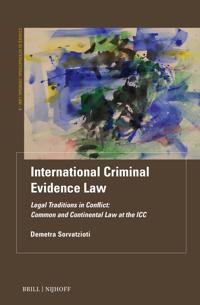
This book examines how the International Criminal Court (ICC) evaluates evidence within its hybrid legal framework, providing a comparative analysis of continental and common law traditions as applied in trial practice. It illustrates how the legal backgrounds of judges influence both conceptual and practical understanding of the prosecutorial burden of proof, the presumption of innocence, and the principle of free evaluation of evidence. These disparities create tensions in the way evidence is assessed.
Focusing on key cases such as Bemba, Gbagbo, and Ongwen, the book identifies recurring challenges, including the tendency to confuse procedural rules with the rigorous reasoning process required by evidence law. It challenges the continental assumption that evidence law is merely a set of admissibility rules. It redefines it as a body of law that offers a structured method of reasoning, supporting a principled approach to the admissibility of evidence at the trial stage and its evaluation at the judgment stage.
The lack of consistent, robust reasoning in the case law of the ICC on evidence issues has resulted in reasoning contradictions, exposing it to criticism. Fairness, transparency, and legitimacy have been compromised, particularly as the principle of free evaluation of evidence, is conceptually incompatible with the prosecutorial burden of proof. However, it continues to be regarded as a safeguard of the presumption of innocence, even during the weighing process at the end of the trial.
The book proposes a bespoke evidence law for the ICC: one that is neither transplanted from national legal orders nor eclectic in design, but uniquely crafted to meet the specific needs of each case. It offers legal scholars, judges, prosecutors, and practitioners a comprehensive analysis of the conceptual misunderstandings that affect evidentiary reasoning at the Court. It argues that a principled approach to evaluating international criminal evidence is essential for developing a consistent body of evidence law for International Criminal Tribunals.
Focusing on key cases such as Bemba, Gbagbo, and Ongwen, the book identifies recurring challenges, including the tendency to confuse procedural rules with the rigorous reasoning process required by evidence law. It challenges the continental assumption that evidence law is merely a set of admissibility rules. It redefines it as a body of law that offers a structured method of reasoning, supporting a principled approach to the admissibility of evidence at the trial stage and its evaluation at the judgment stage.
The lack of consistent, robust reasoning in the case law of the ICC on evidence issues has resulted in reasoning contradictions, exposing it to criticism. Fairness, transparency, and legitimacy have been compromised, particularly as the principle of free evaluation of evidence, is conceptually incompatible with the prosecutorial burden of proof. However, it continues to be regarded as a safeguard of the presumption of innocence, even during the weighing process at the end of the trial.
The book proposes a bespoke evidence law for the ICC: one that is neither transplanted from national legal orders nor eclectic in design, but uniquely crafted to meet the specific needs of each case. It offers legal scholars, judges, prosecutors, and practitioners a comprehensive analysis of the conceptual misunderstandings that affect evidentiary reasoning at the Court. It argues that a principled approach to evaluating international criminal evidence is essential for developing a consistent body of evidence law for International Criminal Tribunals.
- Undertitel
- Legal Traditions in Conflict: Common and Continental Law at the ICC
- Författare
- Demetra Fr. Sorvatzioti
- Upplaga
- x, 248 pp.
- ISBN
- 9789004741003
- Språk
- Engelska
- Vikt
- 557 gram
- Utgivningsdatum
- 2026-02-26
- Förlag
- BRILL
- Sidor
- 248







