Spara
Apocalyptic Eschatology in Early Jewish and Christian Literature
Författare:
inbunden, 2026
Engelska

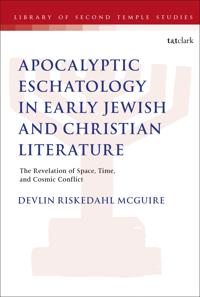
Devlin Riskedahl McGuire argues for a new definition of the term “apocalyptic eschatology” by analyzing the four categories of revelation, space, time, and cosmic conflict. Through careful reading and examination of various Jewish and Christian texts from the late Second Temple period, McGuire seeks to understand and suggest a better definition of apocalyptic eschatology in the texts of this period.
Through a study of eight representative texts — Daniel, the Similitudes of Enoch, 4 Ezra, the Testament of Moses, the War Scroll, the Apocalypse of John, 1 Thessalonians, and the Gospel of Mark — McGuire proposes a new definition of the term “apocalyptic eschatology”. He demonstrates how these writings, in spite of the significant diversity in their expressions and realizations, exhibit enough similarity to be characterized by an explanatory definition that makes sense of their common view of the world. He concludes that apocalyptic eschatology refers to revealed beliefs that anticipate the transformation of space through heavenly intervention, affirm God’s determined time, and portray the eschaton as God’s solution to a cosmic conflict between good and evil.
- Undertitel
- The Revelation of Space, Time, and Cosmic Conflict
- Författare
- Devlin Riskedahl McGuire
- ISBN
- 9780567730503
- Språk
- Engelska
- Vikt
- 446 gram
- Utgivningsdatum
- 2026-11-12
- Sidor
- 256







