Spara
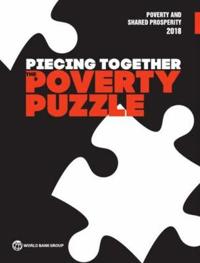
Poverty and Shared Prosperity 2018
The World Bank Group has two overarching goals: End extreme poverty by 2030 and promote shared prosperity by boosting the incomes of the bottom 40 percent of the population in each economy. As this year’s Poverty and Shared Prosperity report documents, the world continues to make progress toward these goals. In 2015, approximately one-tenth of the world’s population lived in extreme poverty, and the incomes of the bottom 40 percent rose in 77 percent of economies studied.
But success cannot be taken for granted. Poverty remains high in Sub- Saharan Africa, as well as in fragile and conflict-affected states. At the same time, most of the world’s poor now live in middle-income countries, which tend to have higher national poverty lines. This year’s report tracks poverty comparisons at two higher poverty thresholds—$3.20 and $5.50 per day—which are typical of standards in lower- and upper-middle-income countries. In addition, the report introduces a societal poverty line based on each economy’s median income or consumption.
Poverty and Shared Prosperity 2018: Piecing Together the Poverty Puzzle also recognizes that poverty is not only about income and consumption—and it introduces a multidimensional poverty measure that adds other factors, such as access to education, electricity, drinking water, and sanitation. It also explores how inequality within households could affect the global profile of the poor.
All these additional pieces enrich our understanding of the poverty puzzle, bringing us closer to solving it.
But success cannot be taken for granted. Poverty remains high in Sub- Saharan Africa, as well as in fragile and conflict-affected states. At the same time, most of the world’s poor now live in middle-income countries, which tend to have higher national poverty lines. This year’s report tracks poverty comparisons at two higher poverty thresholds—$3.20 and $5.50 per day—which are typical of standards in lower- and upper-middle-income countries. In addition, the report introduces a societal poverty line based on each economy’s median income or consumption.
Poverty and Shared Prosperity 2018: Piecing Together the Poverty Puzzle also recognizes that poverty is not only about income and consumption—and it introduces a multidimensional poverty measure that adds other factors, such as access to education, electricity, drinking water, and sanitation. It also explores how inequality within households could affect the global profile of the poor.
All these additional pieces enrich our understanding of the poverty puzzle, bringing us closer to solving it.
- Undertitel
- Piecing Together the Poverty Puzzle
- ISBN
- 9781464813306
- Språk
- Engelska
- Vikt
- 513 gram
- Utgivningsdatum
- 20.12.2018
- Förlag
- World Bank Publications
- Sidor
- 184