Spara
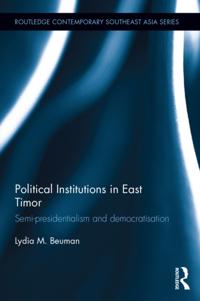
Political Institutions in East Timor
Läs i Adobe DRM-kompatibel e-boksläsareDen här e-boken är kopieringsskyddad med Adobe DRM vilket påverkar var du kan läsa den. Läs mer
In 2002, East Timor became an independent state following a long conflict with Indonesia, and went on to adopt a semi-presidential form of government. In a semi-presidential system there is a directly elected fixed-term president, prime minister and government who are collectively responsible for the legislature. Over 50 countries in the world have adopted such a system.This book examines the politics of semi-presidentialism in East Timor from 2002-2012 and post-2012 political developments. It analyses the impact of semi-presidentialism on the performance of East Timor's democracy, and looks at whether semi-presidentialism encourages power sharing between competing forces, or whether it provoke a power struggle that threatens democratic stability. Using East Timor as a case study, the author explains whether the adoption of semi-presidentialism helps or hinders the process of democratisation in new democracies. It is of interest to researchers in the fields of Political Science, Conflict Resolution and Asian Studies, in particular Southeast Asian Politics.
- Undertitel
- Semi-Presidentialism and Democratisation
- Författare
- Lydia Beuman
- ISBN
- 9781317362128
- Språk
- Engelska
- Utgivningsdatum
- 5.2.2016
- Förlag
- TAYLOR FRANCIS
- Tillgängliga elektroniska format
- PDF - Adobe DRM
- Läs e-boken här
- E-boksläsare i mobil/surfplatta
- Läsplatta
- Dator