Spara
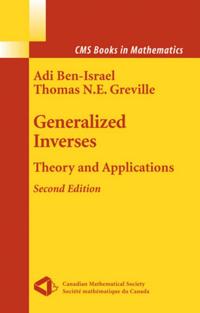
Generalized Inverses
Läs i Adobe DRM-kompatibel e-boksläsareDen här e-boken är kopieringsskyddad med Adobe DRM vilket påverkar var du kan läsa den. Läs mer
1. The Inverse of a Nonsingular Matrix It is well known that every nonsingular matrix A has a unique inverse, ?1 denoted by A , such that ?1 ?1 AA = A A =I, (1) where I is the identity matrix. Of the numerous properties of the inverse matrix, we mention a few. Thus, ?1 ?1 (A ) = A, T ?1 ?1 T (A ) =(A ) , ? ?1 ?1 ? (A ) =(A ) , ?1 ?1 ?1 (AB) = B A , T ? where A and A , respectively, denote the transpose and conjugate tra- pose of A. It will be recalled that a real or complex number ? is called an eigenvalue of a square matrix A, and a nonzero vector x is called an eigenvector of A corresponding to ?,if Ax = ?x. ?1 Another property of the inverse A is that its eigenvalues are the recip- cals of those of A. 2. Generalized Inverses of Matrices A matrix has an inverse only if it is square, and even then only if it is nonsingular or, in other words, if its columns (or rows) are linearly in- pendent. In recent years needs have been felt in numerous areas of applied mathematics for some kind of partial inverse of a matrix that is singular or even rectangular.
- Undertitel
- Theory and Applications
- Författare
- Adi Ben-Israel, Thomas N.E. Greville
- ISBN
- 9780387216348
- Språk
- Engelska
- Utgivningsdatum
- 18.4.2006
- Förlag
- SPRINGER NEW YORK
- Tillgängliga elektroniska format
- PDF - Adobe DRM
- Läs e-boken här
- E-boksläsare i mobil/surfplatta
- Läsplatta
- Dator