Spara
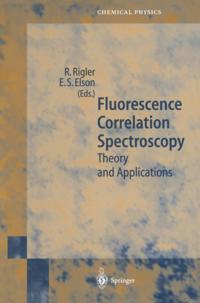
Fluorescence Correlation Spectroscopy
e-bok, 2012
Engelska
Läs i Adobe DRM-kompatibel e-boksläsareDen här e-boken är kopieringsskyddad med Adobe DRM vilket påverkar var du kan läsa den. Läs mer
Fluorescence correlation spectroscopy (FCS) was developed in order to char- acterize the dynamics of molecular processes in systems in thermodynamic equilibrium. FCS determines transport and chemical reaction rates from mea- surements of spontaneous microscopic thermally driven molecular concentra- tion fluctuations. Since its inception, and particularly in recent years, techni- cal and conceptual advances have extended the range of practical applicability and the information obtainable from FCS measurements. Improvements in microscopy, data acquisition, and data processing have greatly shortened the time required for FCS measurements. FCS can now be routinely applied to labile systems such as cells, and for the acquisition of large volumes of data as required for high-throughput screening. Cross correlation methods pro- vide a powerful tool for characterizing interactions among different molecular species. Analysis of the amplitude of concentration fluctuations can provide a wealth of information about aggregation/polymerization process and the compositions of mixtures. Furthermore, FCS provides a bridge between conventional measurements of dynamic processes on a macroscopic concentration scale and the currently developing field of single molecule measurements. Both FCS and single mole- cule approaches measure directly stochastic fluctuations in molecular pro- perties, and so must be analyzed by statistical methods to yield conventional phenomenological parameters. As commonly practiced, FCS yields these phe- nomenological parameters, e. g. , diffusion coefficients and chemical rate con- stants, directly in terms of a fluorescence fluctuation autocorrelation func- tion.
- Undertitel
- Theory and Applications
- Redaktör
- E.S. Elson, R. Rigler
- ISBN
- 9783642595424
- Språk
- Engelska
- Utgivningsdatum
- 2012-12-06
- Tillgängliga elektroniska format
- PDF - Adobe DRM
- Läs e-boken här
- E-boksläsare i mobil/surfplatta
- Läsplatta
- Dator