Spara
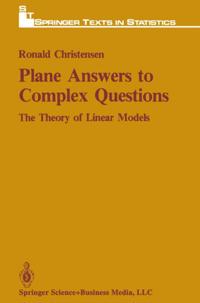
Plane Answers to Complex Questions
Läs i Adobe DRM-kompatibel e-boksläsareDen här e-boken är kopieringsskyddad med Adobe DRM vilket påverkar var du kan läsa den. Läs mer
This book was written to rigorously illustrate the practical application of the projective approach to linear models. To some, this may seem contradictory. I contend that it is possible to be both rigorous and illustrative and that it is possible to use the projective approach in practical applications. Therefore, unlike many other books on linear models, the use of projections and sub- spaces does not stop after the general theory. They are used wherever I could figure out how to do it. Solving normal equations and using calculus (outside of maximum likelihood theory) are anathema to me. This is because I do not believe that they contribute to the understanding of linear models. I have similar feelings about the use of side conditions. Such topics are mentioned when appropriate and thenceforward avoided like the plague. On the other side of the coin, I just as strenuously reject teaching linear models with a coordinate free approach. Although Joe Eaton assures me that the issues in complicated problems frequently become clearer when considered free of coordinate systems, my experience is that too many people never make the jump from coordinate free theory back to practical applications. I think that coordinate free theory is better tackled after mastering linear models from some other approach. In particular, I think it would be very easy to pick up the coordinate free approach after learning the material in this book. See Eaton (1983) for an excellent exposition of the coordinate free approach.
- Undertitel
- The Theory of Linear Models
- Författare
- Ronald Christensen
- ISBN
- 9781475719512
- Språk
- Engelska
- Utgivningsdatum
- 11.11.2013
- Förlag
- SPRINGER NEW YORK
- Tillgängliga elektroniska format
- PDF - Adobe DRM
- Läs e-boken här
- E-boksläsare i mobil/surfplatta
- Läsplatta
- Dator